mSINDy

mSINDy is a modular MATLAB framework for sparse identification of nonlinear dynamical systems from data. The repository provides tools for equation discovery, sparse regression, candidate-library construction, model validation, and data-driven analysis of linear, nonlinear, and chaotic dynamics using SINDy methodologies.
modular Sparse Identification of Nonlinear Dynamics
mSINDy - modular Sparse Identification of Nonlinear Dynamics is a modular MATLAB framework for data-driven discovery of governing equations in nonlinear dynamical systems based on sparse regression and the Sparse Identification of Nonlinear Dynamics (SINDy) methodology.
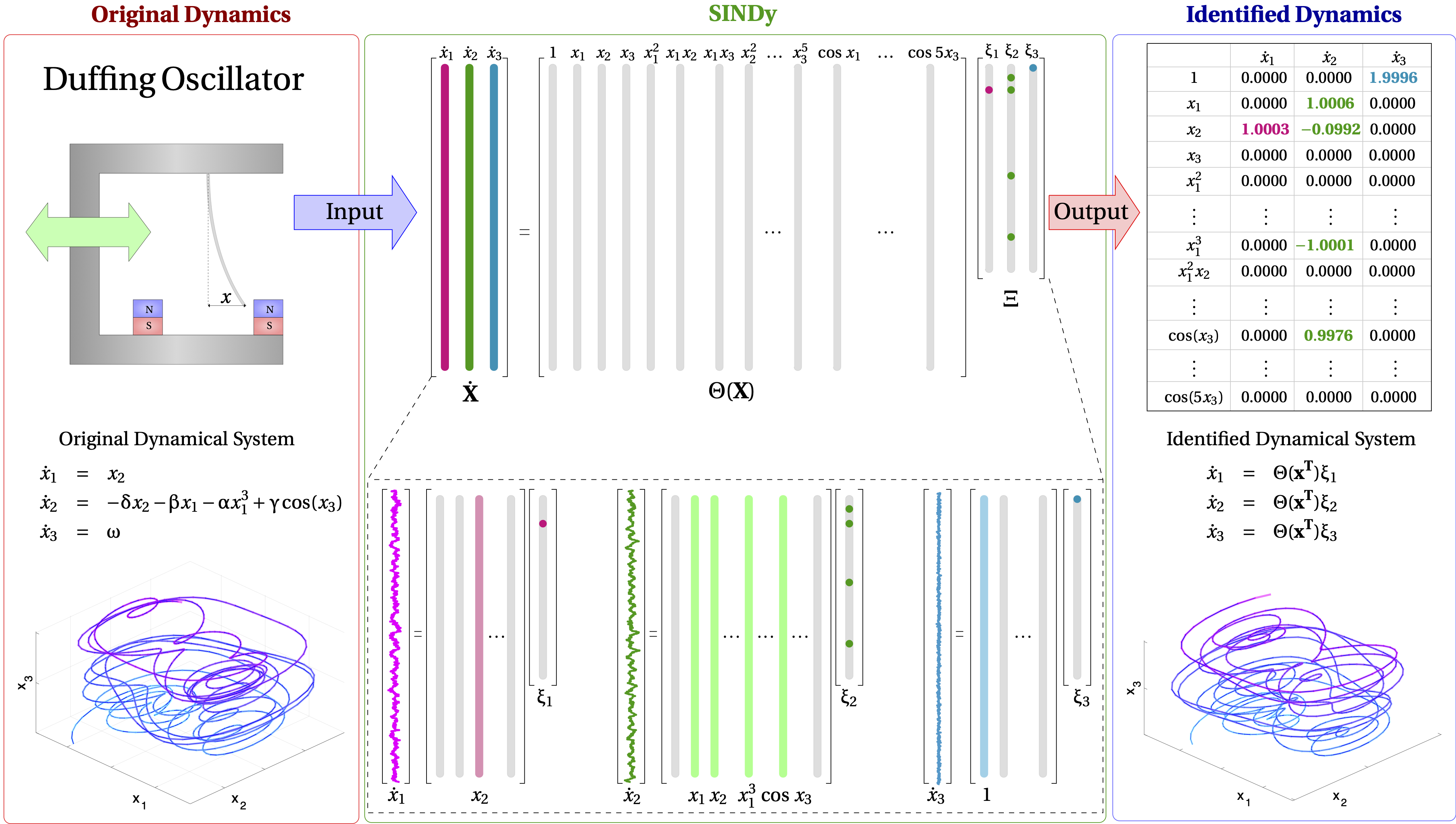
Table of Contents
- Overview
- Features
- Usage
- Documentation
- Authors
- Citing mSINDy
- License
- Institutional support
- Funding
- Contact
Overview
mSINDy was developed to support the identification, reconstruction, and interpretation of nonlinear dynamical systems directly from data, with emphasis on:
- Sparse Identification of Nonlinear Dynamics (SINDy)
- Sparse regression for equation discovery
- Data-driven identification of governing equations
- Reduced-order and interpretable dynamical modeling
The framework is designed to bridge theoretical concepts and practical computational workflows, including scenarios involving noisy measurements, nonlinear oscillations, chaotic dynamics, and limited observational data.
This repository accompanies the developments presented in:
- A. Cunha Jr, C. A. Lampe, J. H. C. Gaspar-Elsas, and J. C. V. Fernandes, Data-driven Evolution Equations via Sparse Identification of Nonlinear Dynamics. In: Scientific Machine Learning for Predictive Modeling: Bridging Data-Driven and Physics-Based Approaches in Computational Science and Engineering, edited by A. Cunha Jr, F. P. Santos, F. A. Rochinha, and A. L. G. A. Coutinho, Springer, 2026.
Features
- Sparse identification of governing equations from trajectory data
- Polynomial, trigonometric, exponential, and logarithmic candidate libraries
- Sequential Thresholded Least Squares (STLS) sparse regression
- Sparse coefficient selection and model interpretation
- Reconstruction and prediction of nonlinear dynamics
- Validation using unseen initial conditions
- Handling of noisy datasets and derivative estimation
- MATLAB implementations for pedagogical and research applications
- Reproducible workflows aligned with published studies
Usage
To get started with mSINDy, follow these steps:
- Clone the repository:
git clone https://github.com/americocunhajr/mSINDy.git - Navigate to the package directory:
cd mSINDy/mSINDy-1.0 - Run the mSINDy tutorials provided in the corresponding folders
The code includes the following examples:
- Linear harmonic oscillator
- Duffing oscillator
- van der Pol oscillator
- Rossler chaotic system
Documentation
The routines in mSINDy are well-commented to explain their functionality. Each routine includes a description of its purpose, along with its inputs and outputs. Detailed documentation can be found within the code comments.
Authors
- Americo Cunha Jr
- Cesar Augusto Lampe
- José Hugo Capella Gaspar-Elsas
- Júlio de Castro Vargas Fernandes
Citing mSINDy
If you use mSINDy in your research, please cite the following publication:
- A. Cunha Jr, C. A. Lampe, J. H. C. Gaspar-Elsas, and J. C. V. Fernandes, Data-driven Evolution Equations via Sparse Identification of Nonlinear Dynamics. In: Scientific Machine Learning for Predictive Modeling: Bridging Data-Driven and Physics-Based Approaches in Computational Science and Engineering, edited by A. Cunha Jr, F. P. Santos, F. A. Rochinha, and A. L. G. A. Coutinho, Springer, 2026.
@incollection{mSINDy2026,
  author    = {A. Cunha Jr and C. A. Lampe and J. H. C. Gaspar-Elsas and J. C. V. Fernandes},
  title     = {Data-driven Evolution Equations via Sparse Identification of Nonlinear Dynamics},
  booktitle = {Scientific Machine Learning for Predictive Modeling: Bridging Data-Driven and Physics-Based Approaches in Computational Science and Engineering},
  editor    = {A. Cunha Jr and F. P. Santos and F. A. Rochinha and A. L. G . A. Coutinho},
  publisher = {Springer},
  year      = {2026},
  address   = {Cham},
  url       = {https://sindycode.org},
}
License
mSINDy is released under the MIT license. See the LICENSE file for details. All new contributions must be made under the MIT license.

Institutional support



Funding



Contact
For any questions or further information, please contact the third author at:
- Americo Cunha Jr: americo@lncc.br